Would this have happened if he was white?
- Paul Fry
- Jul 8, 2016
- 6 min read
The backlash was appalling, you could argue disproportionate. But the gunning down of police officers in Dallas was clearly not unconnected to two separate fatal police shootings of black men in the United States in two days.
Such shootings are a shocking occurrence. This latest one the more so because if was played out on Facebook, streamed live.
As Philando Castile's head slumps backward while he lies dying next to her, Diamond Reynolds looks into the camera and explains that a Minnesota police officer just shot her fiancé four times. Live on the internet. As she said later: "What else could I do? Who else can you complain to when something like this happens?
"I wanted it to go viral so the people could see what happened. I wanted everybody in the world to see what the police do."
In the video, Reynolds speaks and turns her camera to Castile, who's wearing a blood-covered white shirt. A police officer is visible out the window of the car, with his gun drawn. They had been pulled ovefr for a faulty tail light and had their hands up as the officer demanded.


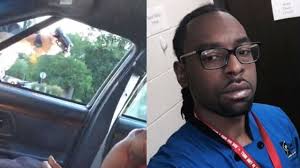


The aftermath of the shooting, the victim and (right) relatives and friends console each other
The world is, by now, accustomed to grainy cell phone videos of officer-involved shootings, but this footage from Falcon Heights, outside Minneapolis, (above) is something different: a woman live-streaming a shooting's aftermath with the police officer a few feet away, his gun still trained on his bloody victim.
"He let the officer know that he had a firearm and he was reaching for his wallet to show the licence and the officer just shot him in his arm," Reynolds said.
She later accused the St. Anthony police of racism and poor treatment of her and her young daughter, who was in the car at the time of the shooting.
"They took me to jail. They didn't feed us. They didn't give us water," she said. "They put me in a room and separated me from my child. They treated me like a prisoner."
Reynolds said police dropped her off at her home at 5 a.m. next day. The officer who she said shot her fiancé cried after the shooting. She said she wants him arrested and charged with murder.
"(He) should not be home with his family. He should be in jail in handcuffs."
Castile was a good man, she said, who worked for a local school district and had never been in trouble with the law.
As Reynolds said, victims of police shootings have no authorities to call, no higher-ups to summon. In these situations, police are witness, assailant, and first responder - all three.
Throughout history, that fact has left victims with little recourse. In recent years, social media has changed that dynamic, giving bystanders a way to document these all-too-frequent acts of violence. It’s what happened in the cases of Michael Brown in Ferguson, Missouri, and Walter Scott in Charleston, South Carolina. It’s what happened in the case of Alton Sterling in Baton Rouge, Louisiana, this week.
But Reynolds’ live video was different. Not just a documentation of what happened, it was also a real-time cry for help. Unable to call the authorities as she watched her loved one slip away, Reynolds instead called on the public.
The country has had a black man in the White House for eight years and yet it seems racial tensions are now at a height last seen during the Watts Riots in Los Angeles in 1965. Tensions have been inflamed by law enforcement attitudes that shame and undermine their Protect and Serve pledge.

President Barack Obama said all Americans should be "deeply troubled" by the shootings in Baton Rouge, Louisiana, and St Paul, Minnesota.
In a statement - on Facebook - he said: "We've seen such tragedies far too many times, and our hearts go out to the families and communities who've suffered such a painful loss."
Obama said it was clear the fatal shootings were not "isolated incidents".
"They are symptomatic of the broader challenges within our criminal justice system" and the "racial disparities that appear across the system year after year", he said.
What it must be to be a black person in America...
Remember the outrage after the shooting of an unarmed Michael Brown in Ferguson, Missouri, in August 2014, not two years ago? When it comes to racially lopsided arrests, the most remarkable thing about Ferguson, it turns out is just how ordinary it was.
Police there arrest black people at a rate nearly three times higher than people of other races.
At least 1,581 other police departments across the USA arrest black people at rates even more skewed than in Ferguson, analysis of arrest records shows.
That includes departments in cities as large and diverse as Chicago and San Francisco and in the suburbs that encircle St. Louis, New York and Detroit.
Those disparities are easier to measure than to explain. They could be a reflection of biased policing; they could just as easily be a byproduct of the vast economic and educational gaps that persist across much of the USA — factors closely tied to crime rates. In other words, experts said, the fact that such disparities exist does little to explain their causes.
"That does not mean police are discriminating. But it does mean it's worth looking at. It means you might have a problem, and you need to pay attention," said University of Pittsburgh law professor David Harris, a leading expert on racial profiling.
Whatever the reasons, the results are the same: Blacks are far more likely to be arrested than any other racial group in the USA. In some places, dramatically so.
At least 70 departments scattered from Connecticut to California arrested black people at a rate 10 times higher than people who are not black, an investigation by USA TODAY found.
"Something needs to be done about that," said Ezekiel Edwards, the head of the ACLU's Criminal Law Reform Project, which has raised concerns about such disparate arrest rates. "We shouldn't continue to see this kind of staggering disparity wherever we look."
Every year, traffic stop data compiled by Missouri's attorney general showed Ferguson police stopped and searched black drivers at rates markedly higher than whites.
Nationwide, blacks are stopped, searched, arrested and imprisoned at rates higher than people of other races. USA TODAY's analysis, using arrests reported to the federal government in 2011 and 2012, found that those inequities are far wider in many cities across the country, from St. Louis to Atlanta to suburban
Protesters in Chicago, New York and St. Paul, Minnesota, took to the streets this week to express outrage after the St Paul incident. And Minnesota Governor Mark Dayton said there was "every indication" police conduct in the fatal shooting was "way in excess" of what the situation warranted, and that race may have played a role.
"I can't say how shocked I am and how deeply, deeply offended that this would occur in Minnesota to somebody who got pulled over for a tail light being out of order," Dayton said, calling the situation "absolutely appalling" on all levels.
"Would this have happened if those passengers, the driver and the passengers, were white? I don't think it would," he said.
Reynolds described the officer who shot Castile as Asian.
The death happened in the St. Paul suburb of Falcon Heights, a mostly white community of 5,000 that is also home to Minnesota's annual state fair and part of the massive University of Minnesota campus.
Castile's mother suspected she would never learn the whole truth about her son's death.
"I think he was just black in the wrong place," Valerie Castile said, adding that she had stressed to her children that they must do what authorities tell them to do to survive.
"I always told them, whatever you do when you get stopped by police, comply, comply, comply."

Riots in Ferguson, Missouri, in 2014 after the shooting of teenager Michael Brown
In many US cities, because the police services are financially incentivised, there are places with more outstanding arrest warrants than citizens. New York City alone has 1.4 million open arrest warrants for unresolved summonses dating back to the 1980’s.
None are for serious or violent crimes. They’re for “quality of life” offenses like loitering, public urination, walking a dog without a leash, or being in a park after dark.
Between 2003 and 2013, New York City police issued more than 6 million summonses for low level crimes – in a city of about 8.4 million.
When issued a summons, a person must appear in court on a specific day and time, and usually ends up paying a fine ranging from $25 to $250. But nearly 40 per cent of people issued a summons fail to appear in court, resulting in a judge automatically issuing an arrest warrant.
A person who’s stopped may resist arrest arrest or flee because of that outstanding warrant. And so, we are unnecessarily putting police officers in peril. They will be extremely stressed when approaching a stopped car, which could explain why the St Paul officer fired as the driver went for his documents in his wallet when instructed.
New York has brought in amnesties for warrants for minor incidents to help clear the backlog, enable people to start again with clean records - which can go against them at work - and reduce tensions.


Comments