EXCLUSIVE: Former Stevenage Boro owner Victor Green talks from Los Angeles
- Paul Fry
- Feb 5, 2022
- 14 min read
His first interview since he sold the club two decades ago...

Victor Green as chairman of Stevenage Borough FC
It is breakfast time in Los Angeles and it is already a balmy 13C and the Mercury on its way up to an enviable 20C. Not bad for early February.
Victor Green looks tanned, relaxed – and barely changed from when we last spoke, more than two decades ago. He is anticipating another busy day, despite being in the ninth decade of his life. Since selling his controlling interest in Stevenage Borough Football Club in the late 1990s, he has built a number of business interests on the West Coast.
Home is in Westwood, in northern LA, a few minutes’ drive from the glitz of Beverly Hills and Hollywood.
"I could never have imagined myself living out here full-time all those years ago. It was never on my radar. But I absolutely love it,” he says. “My wife is American, a Californian. For a time we lived half the year here and half in the UK, alternating every three months. Then one cold, rainy day back there, I thought 'what the f*** am I doing here!? I've never looked back since we made a permanent home here.
"We have been in this house 18 years and every day we wake up to blue skies.... winter here is 65-68F. What’s not to like?
"People go on about the state of the traffic but nothing compares to London. We have four-lane highways here... if someone is driving from Beverly Hills to Santa Monica and it normally takes them 15 minutes and takes them 25, it's a disaster.
“But I used to drive into London. It would take me an hour and a quarter to do nine miles."

He says everything is structured around people's comfort, with connections to interstates and freeways every couple of blocks. “In Beverly Hills it is all free valet parking. At stores, restaurants... they even have valet parking at my gym."
The lifestyle must agree with Victor, of whom there has been radio silence since he sold the football club to Phil Wallace 21 years ago. Phil, interviewed for my book Town’s Got Talent, has told me there was little small talk when they did a deal, with Boro just 24 hours from financial oblivion. Naturally, Victor's recall is somewhat different.
"Phil painted himself as the shining knight, and that's fine. For me, it was a huge weight off my shoulders when I left.
"I don't think the supporters realise the burden of owning and running a club. It's not just about a few players.
“You have the entire stadium to care for, dozens of staff on match day; you have to worry about the burgers, the hotdogs - will they be ready? Are the security staff going to turn up? Is the medical assistance on hand as you need it? The programme sellers, are the punters in hospitality being looked after? So many things.
"But I loved having my own football club. I love football. I love winning. But you can get some awful flak when you don’t win.
"I was invited by Ken Bates, of Chelsea, to a Cup semi-final replay against Manchester United and I was sat next to United chairman Martin Edwards (pictured below). There had been takeover bids for United and I asked him how they were going. He said: ‘Please don't mention them. I am getting pilloried here, at home, my family – so many hate letters.
"I said, 'You have created the largest and best football club in the world. They are not appreciating what you have done - and now you are taking them to even better days. I don’t understand it'.
"He said, 'Victor, I can't get out of my house because of protests.'
“Listening to all this, I went home and woke in the night and I thought, 'if he is getting a hard time, what chance do I stand?'
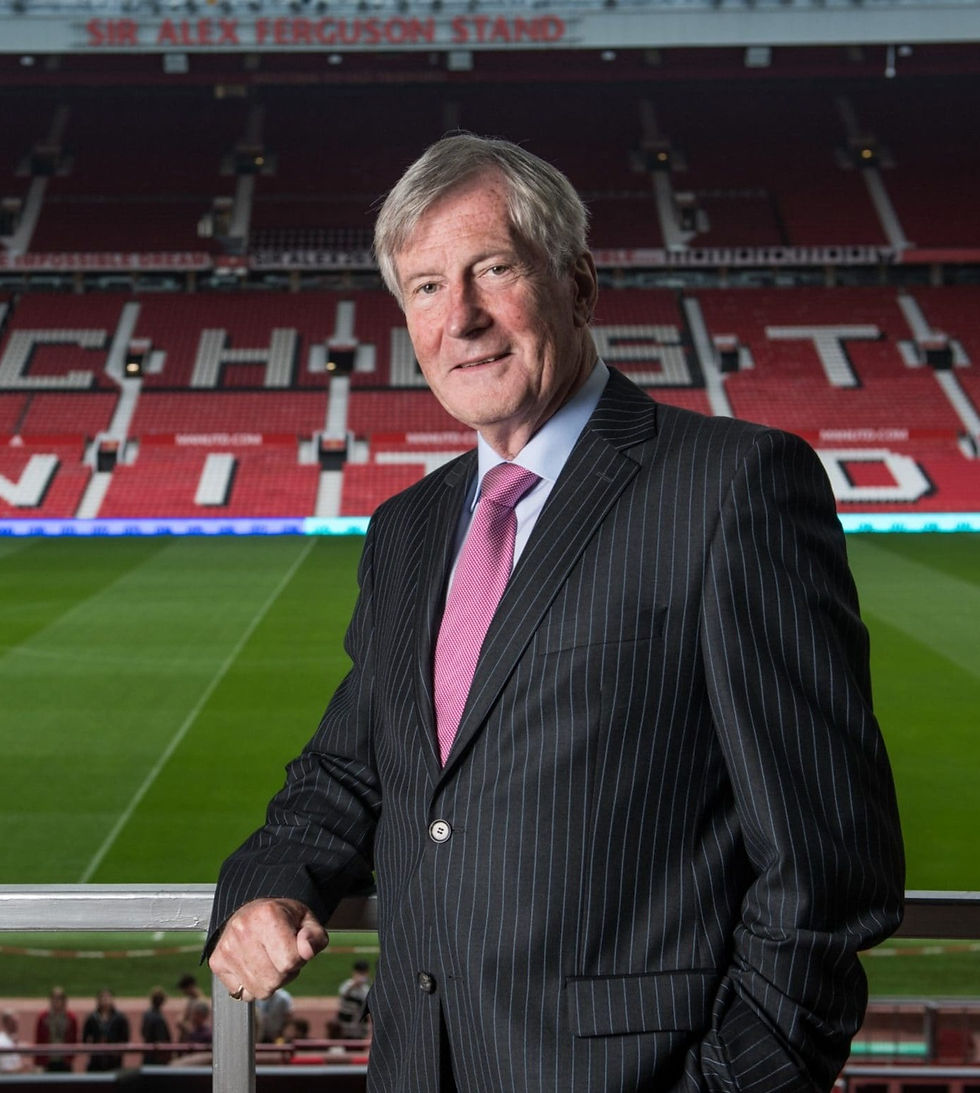
"Owning a football club is like having a tap: it is draining money but you can't turn the tap off. Then you have supporters who can be so ridiculous with their comments. They think everything can be solved by throwing money at it. But it can't.
"So I thought I must be nuts to carry on - it is a 24/7 job, I was involved in every part of the club. I'd get phone calls at all hours and I wondered 'what am I getting out of all this?' It made no sense any more. "The only saving grace looking back is there was no social media then - I would have been crucified. It is a different level nowadays.
"Phil is a different sort of guy, very low profile but that is not my way."
Phil Wallace says Victor handed him the platform to take the club forward into League 2 - and, for a time, the upper echelons of League 1.
Victor recalls his own arrival at Broadhall Way. "There was a crappy shed where the players changed, it was an awful place. We'd have 300-350 supporters in for a home game. I thought that if I started to get a profile, it would help build the club. We got the crowds up to 2,000, 2,500. But you can’t please everyone.
“I didn't mind taking the flak. I have broad shoulders. If you put your head above the parapet you are there to be shot at.
"My concern was that everybody should know about Stevenage, and our own surveys showed people began to come from a good distance to find out what I was all about and what we were building at Boro.
"Then of course we had the high profile FA Cup games with Newcastle in 1998. That was off the scale.
“From the moment we were paired in the draw, I decided I was going to stand my ground. I am not going to let them p*** all over me.
“I enjoyed it. We milked it... TV twice, which was worth £450,000 for the club. We had Sunderland fans buying our shirts to wind Newcastle up.

Boro celebrate their 1-1 draw against Newcastle in February 1998
“The Sun sponsored the game and we had Stevenage Girl - they found twins. Four million people were reading the paper every day and if people hadn't heard of us before then, they soon did.
“We were even on Newsnight, with Jeremy Paxman asking if Newcastle manager Kenny Dalglish was a big girl’s blouse for wanting to switch the game to their place.
“I enjoyed the fight with Newcastle but Freddy Shepherd (pictured below), their chairman, was an a******* and Dalglish was very bad. But everything he did worked against him.
“The nicest thing to come out of it all was when we went up there for the replay and I met their owner, Sir John Hall, who took me aside and apologised.
“He said he had been embarrassed by the way the club dealt with us. He said it was appalling what had happened.
“Dalglish had started by saying he didn’t want to play at Stevenage. He went on about Heysel and crowd safety. I told him we had a full safety certificate. I invited him to speak to the county safety officer but he kept calling me and Paul Fairclough to try to get us to change the venue.

“In the end, I told him: ‘Let’s be frank: you are effing scared of playing us. I said we’d play them at Hackney Marshes if we had to – and one newspaper stunted up a game there just for the fun of it!
“After we drew 1-1 at our place, Dalglish criticised the match ball – then it was pointed out he had endorsed the ball with his signature and he got paid for the ball maker using his name.
“Before that game, a contingent of officials from Newcastle turned up out of the blue one morning and knocked at the door. We kept them hanging on for about half an hour. Then the news cameras arrived and caught all the conversations.
“I told them: ‘I don’t mind showing you round the ground – but you didn’t have the common courtesy to let us know you were coming’. It came across like a midnight raid. And again that backfired on them. They looked like bullies. I think anyone who wasn’t a Newcastle fan wanted us to win.
“We even had Sunderland fans buying our shirts so they could taunt Newcastle supporters they knew.
“We eventually had an FA hearing in our boardroom to see if the game could go ahead. I told them straight: ‘If you treat them any differently to the way you treat us, I will create f****** hell.
“One of them said afterwards: ‘I think we have found the Ken Bates of the Conference,’ which made me laugh.
“It was Newcastle’s arrogance that riled me. They were on about us showing them no respect. But our players were all holding down jobs while theirs were on big money. I said it was they who should show us some respect for their achievements.
“The Times did a thing ‘David and Goliath’... they contrasted the players and their earnings and, there were ours.. he’s a painter, he’s a postman and so on.
“It wouldn’t have taken much for them to show our players some respect. People would have thought more of them.
“After the game, they wouldn’t change shirts. A week later they sent a few down. Their players were told not to say anything to the papers. It was all very sad.

Kenny Dalglish and Alan Shearer, who was making his first appearance after a long injury
“Then there was the fax that Graham Roberts, one of our former players, sent before the replay up there, saying he hoped they stuffed us. It found its way into our dressing room and was found by our kit man. But I knew the chairman of Yeovil, a very nice man, and he was furious the fax was sent on his club’s headed paper. They sacked Graham straight away.
“We were in our hotel in Newcastle before the game and I accidentally dropped the fax and a reporter picked it up and got the story!
“I remember we had a young fullback, James Dillnutt, who came through our education scheme, EFCO, and of his first six games, two were against Newcastle. He got his chance because Ryan Kirby was suspended and he did well.
“But he was so young and inexperienced he thought you got to play games like this every week in front of crowds of 45,000!
“It was such a memorable episode though and it did so much for the club’s profile. Perhaps more so than winning the Conference in 1996.”
Victor clearly relishes a scrap and says Stevenage is such a political town – so it was somewhat inevitable he’d have his spats with the Borough Council.
“Brian Hall, the council leader, was like Svengali, a Lenin-type figure. He controlled the place and ruled through fear. He and I had big fights – sometimes they almost came to blows. But I stood up to him.
“I remember once being invited to see Lord Cobbold at Knebworth. He said: ‘I really wanted to meet the person who could shout and swear Brian Hall and get away with it!’.
“I was trying to buy the ground from the council. I wanted it as a club asset. The meeting was going well, then things stalled. I took Brian aside and told him: ‘Stop playing bloody games. Either you want to sell it or you don’t! I was shaking with rage.

Ken Vale, who Victor succeeded as Boro chairman
“We had such fights. Everyone around him was so scared of him. But we got on quite well.
“I came to Stevenage initially at the invitation of Ken Vale, another former Mayor. I was chairman of Hendon and wrote to Stevenage as I wanted to find a club I could develop. Ken rang and said he was the club chairman and invited me to replace him in the role.
“He said: ‘We liked what you have been doing and we want a big club here. We will fund things while you move the club forward. I’d heard of poaching players – but never a chairman!
“I said I would only take it on if they would support me in improving the ground. They had a meeting and I was in London at a restaurant for dinner and there were no cellphones. I gave them the restaurant number and they called to say the deal was off because the vote didn’t go Brian’s way. I told Brian I didn’t think I could trust him.
“But eventually they gave me a commitment to get the ground ready for the Conference and commit to all ongoing improvements should we go up the leagues. I had it in writing.
“I loved every minute of my time at Boro, even with all the problems. We had some great times and some great players.
“We did well from Barry Hayles, who moved on for a big fee. The finest for me was Steve Berry. He was class on legs. Outstanding footballer, nice guy, great captain. He was a pleasure to watch and to talk to. He was captain when we won the Conference.”
The Football League blocking Boro’s promotion still rankles with Victor, though he accepts the eventual outcome, even now.
“The decision the judge came to in the court challenge was right. The FL were very arrogant and it was a closed shop. It was set up to avoid their member clubs dropping out of the league. I went to the council in about September 1995 and said I wanted to get the ground done in a hurry as I fancied us – only the champions would be promoted back then, not the top two like now.
“I put a £1,000 bet on us at 20-1 to win the league and put the winnings into the club.
“Brian Hall said he thought we needed a social club to add to our revenue stream. I said I would - but the priority at that time was the stadium. They allocated some funds but said it had to go towards a social club or the money would be taken away.

Mark Smith clears in the replay at Newcastle but the goal is given
“I remember we were drawn in the Cup at Hereford and took about 1,300 with us, it was amazing. Brian came along and I said… ‘these are the people who want to see us get promoted. They are also the ones who vote for you, yet you are stopping us getting the bloody thing done’.
“He looked around then said, ‘OK, go and get the thing done’. But this was October and we had to get it sorted by a deadline of December 31. The issue was we could not get the steel anywhere. It would take two or three months, so I went to the FL and asked for an extension on the deadline but they were adamant.
“I said, ‘Do you really expect a club in the lower league to spend millions on their ground, not being sure of promotion the following May? It was unfair, it was ridiculous. Surely the following August would have been fairer?, I said. I rang round everywhere I could think of to get steel but it was hopeless.
“But we eventually got the groundwork done by the start of the following season. But I went to the lawyers and they felt we had a strong chance of challenging the league ruling. It was a high profile case for them. The judge said he couldn’t award it to us because Torquay would be relegated and they had not had enough notice that they would be relegated. I can understand they were the innocent parties. I saw the logic. But the judge also told the league he never wanted to see a case like this come to court again. He also didn’t award the league costs, which was a partial win.
“I blame the Conference for not pushing for an extra promotion place they were too subservient – I think our case laid the ground for that additional place. I also went to appeal and they upheld the judgment, unfortunately.
“We had a lot of support from other clubs higher up the leagues and got offers of pre-season games. They saw our viewpoint.
“I think that had we gone up at that time we would have done extremely well. I remember saying at the time that my ambition to win the top division. I think we could have got into the one below, as Luton did. Whether we could have got further…
“I had designs drawn that could have taken the stadium up to 30,000 capacity. I had designs with a turret on the Broadhall Way corner, that housed a control box, media and hospitality. I even spoke to Lord Cobbold about possibly moving the ground onto part of his land. They were just initial talks but he was open to exploring the idea.

James Dillnutt guards the post
“The thing I was most proud of was the EFCO (Education Football Career Opportunity) scheme. Before that there was the horrible YTS scheme for kids – they treated them like dirt. They would be cleaning boots and sweeping the stands, with little emphasis on education; it was pure exploitation.
“I always believed education was important, especially if players didn’t make the grade and the link with Roger Gochin at the college made it happen.
“James Dillnutt was the first graduate to reach the first team and that was a big thing. It was a forerunner of today’s academies. The PFA were not happy but I challenged them to compare their syllabus with ours and they went quiet.
“It is such a big gamble investing in young players. I went to an Under-11s final not long after I took over and I was horrified by the language the parents were using from the sidelines. Later we had an open meeting and I laid into them. I said there was no place for that in the club.
“It is ridiculous that these young players get spoiled with such crazy money at such a young age. They won’t see much of it themselves because of all the hangers-on and there needs to be a close management system where the money they are given is controlled.”
How does he view the Stevenage story since he moved on?
“I personally think there has been a lack of ambition. The club was were lucky not to be relegated last year and the ship appears to have been steadied this season. But I think they will alternate between League 1, 2 and the National League over any 10-year spell. And that is just how it is.
“To get any higher, it would need an injection of millions and I can’t see that happening. The only way to increase the gates is to keep winning and that is unsustainable. Teams have cycles before needing to be rebuilt and it is not an easy thing to do.
“I had to admire what the club did during the pandemic for local people. I didn’t have to face that but I would have dealt with things as I always do a challenge… I think streaming the games was the right thing, too.
“I would have set up a Covid test site. But the club did very well and I know other clubs went on to do similar things for their communities.”
Clubs below the highest echelons don’t make money but should those biggest clubs do more for the rest?, I asked.
“I think they should, but why would they? It is not in their short-term interests. If you know a few people, you can get a good pre-season game or a decent loan player - but they do things to their own agenda.”
The manager-chairman relationship is key at any club and Victor says of Paul Fairclough, who was in charge during his time in charge: “It wasn’t as close as some people might think. He would say much the same about me, I’m sure. He was a good manager, as his record with us shows.
“But our relationship deteriorated as it went on, in truth. It soured and, with the board ,we decided to bite the bullet and let him go. It was a pity.”
“Generally looking back I enjoyed my time there. We got a buzz going in the town, with people talking about us and following our progress. It is a shame it took so long to make that final step into the Football League.
“I did get to work with some fabulous, dedicated people who had the club at heart.
“I hear from John Jackson, who was the finest supporter, and worked not for anyone else but for the benefit of the club.
“We had a brilliant commercial manager, Clive Abrey, who built a great deal of goodwill for the club over many years. Mike Palmer was very supportive at board level and, of course, we had dear Jim Briscoe, who was a one-off… he and his A Team of volunteers did so much good work around the stadium. The club was in his blood.”
Victor was always the showman - and there are worse things to be accused of in the great scheme of things.
That template was shaped by his earliest days in business and he has written a book, How to Succeed in Business, sharing his knowledge and experience.
He left school at 15 and his first job was in a men’s clothing store. At 20, he joined a publishing company, selling advertising space in various trade and technical magazines. He became General Manager of the company and at 30 started his own publishing company. He then started another company that organized trade exhibitions, conventions and conferences. The publishing company was sold via a management buyout and the exhibition business was sold a few years later.
He later started businesses in printing, marketing and PR, photography, finance, manufacturing, real estate, soccer clubs, web design and direct selling on the internet, as well as men's shoe manufacturing. These were either sold or merged.
He still has the business bug which took him into football. And he hasn’t lost his enthusiasm for either, even if there is zero chance of him getting back into the game. “I had offers, especially straight after Boro, but it was time to move on.
"I have no regrets, especially about my time at Stevenage. It was a big part of my life," he says.
Our time on Zoom has flown by…so have the years since Stevenage Borough FC was the club that Victor Green built


Comments