One small step for a 99...
- Paul Fry
- Jul 26, 2016
- 4 min read
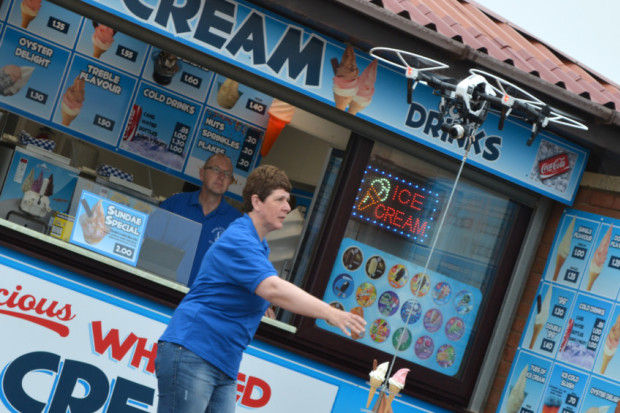
As tech revolutions go, it is not quite the Wright Brothers. Or Louis Bleriot, or even Amy Johnson. But the race is on to make aviation history.
It might not bring us cheap flights to new corners of our planet, but in time it could change our lives in similarly significant ways that we can only begin to imagine as science fantasy becomes science fact.
And if the boffins haven't quite got it licked, we consumers might soon have...
Sunbathers in Lincolnshire (no, don't laugh, they really do exist) are close to having their 99s delivered direct to their deckchairs, thanks to the UK’s first ice- cream delivery drone.
Really. Robots flying fully-loaded ice-cream cones suspended on a pole over unsuspecting beachgoers’ heads... what could possibly go wrong? Well, not much, by apparently.
Rock & Ices in Mablethorpe, say initial trials of their pioneering drone delivery scheme along the seafront, some four miles of golden sands, have been a success and they are looking to roll out the service.
It is thought to be the first trial of its kind in the UK. Sweaty, sanded-up punters would be able to order their cooling cold treats from a menu with a mobile app.
In the US, a chicken sandwich, a coffee, some donuts and a Slurpee have already made it into the aviation annals.
They were part of a series of packages dropped off to a 7-Eleven customer in Reno, Nevada, in the first fully autonomous, officially-approved drone delivery to a residential home.
The coffee was hot, the drink cold and the sandwich edible.
One small step for man, but a giant leap for consumers – and many industries looking to change the commercial landscape.

This is a future that will ensure while we are all getting fat enough eating takeaways, we soon won't have to rouse ourselves to walk it off in advance by making the troubling trek to the shop to buy our dinner.
Separately, Amazon is to partner with the British government to run tests exploring the viability of delivery of small parcels by drone – the first time such tests have been run in the UK.
A cross-government team supported by the Civil Aviation Authority (CAA) gave permission to Amazon to explore three key areas: operations beyond line of sight, obstacle avoidance and flights where one person operates up to 100 autonomous drones.
The experiment will look at drones carrying deliveries weighing 2.3kg (5lb) or less – which make up 90 per cent of Amazon’s sales.
UK law dictates that drones cannot be flown within 50 metres of a building or a person, or within 150 metres of a built-up area.
Drones also have to remain in line of sight and within 500 metres of the pilot, which has hampered attempts to use drones for delivery or surveillance purposes before.
During the test the drones will be limited to an altitude of 400ft (122m) and kept away from operating near airport flightpaths.
Amazon said making sure the system can operate safely is the top priority of the tests.
Amazon is also testing its drones in the US but faces major restrictions. The US Federal Aviation Administration (FAA) will only allow commercial drones to fly where the drone and its load weigh less than 55lb, it stays within unaided sight of the pilot and each drone has its own pilot.
Commercial drones can also only fly during daylight, from 30 minutes before sunrise until 30 minutes after sunset. The same rules do not apply to recreational drones.
The online retailer is not the only company developing and testing drones for delivery in the US. Google recently showed off a fixed-wing drone system capable of carrying packages.
The most promising tests have come from drone manufacturer Flirtey. It partnered with the FAA and Nasa for a ship-to-shore test in New Jersey in June this year as a potential disaster-relief delivery method.
Among other allied developments being considered by Amazon are drone vans with 3D printing facilities – so small items can be printed virtually at your door – and using churches street lights as recharging “perches”.
If nothing else, it could make for a bizarrely sinister remake of Alfred Hitchcock's The Birds.
It is easy to be cynical. Drone delivery is appealing because it does not involve a human and can get packages from A to B faster than by truck – especially to remote areas. But drones, yet at least, can't outperform a man with a van. They are limited with capacity and ranges, besides the obvious safety concerns.

Amazon's trial delivery drone (Pic; Amazon)
The experts would have us believe this is all just around the corner. It could be majorly transformative – with huge implications for many low-paid delivery workers – or something that will, perhaps like the Kindle book system, storm in then fall back to find a middling place, as we have seen with a resurgence of proper books.
The underlying feeling though is that automation, robots and the like offer a major threat to society and the way we survive economically.
Finland is considering introducing universal basic income in 2017. Around 10,000 people would receive €550 each month if the government decides to implement the scheme in a trial project.
A working group has advised the government to launch the tax-free wage, equivalent to unemployment and welfare benefits that cover food, personal hygiene and clothing, in 2017 for two years.
The income would be unconditional and would not involve being means-tested for benefits. It would replace part of Finland’s social security net.
Universal basic income is also being considered in Switzerland, the Netherlands and France.
It remains to be seen whether this idea – like those ice-creams in Mablethorpe – ever get off the ground.


Comments