The betting industry is out of control. Odds-on that nothing is done.
- Paul Fry
- Jan 28, 2020
- 8 min read

Imagine gambling away all the money you had saved for your dad's funeral, or the secret shame of frittering away a few quid you had set aside for the kids.
A quite shocking set of statistics emerged this week highlighting how the number of women reporting a gambling problem has risen at double the rate of men in the past five years.
GamCare, which runs the national gambling helpline, says the issue is down to the ease with which women can now gamble online using their phones.
In the past, women had to brave the male-dominated realm of the bookies or find the time and risk the exposure of an arcade. Now, 70% of female gamblers use apps and websites.
Dr Henrietta Bowden-Jones, founder and director of the National Problem Gambling Clinic, says, “Many women won’t seek help because they’re afraid of having their children taken away. Some have embezzled or stolen money and fear prison if they’re discovered.”
Ian Semel leads Breakeven, a charity supporting gambling addicts. He believes the latest figures hide the true number of female problem gamblers, because so few reach out for help.
“There’s such a stigma for women gamblers,” he says. “Society has very clear gender roles for women and expectations that they’ll be the caregivers.” To breach this risks “judgment, exposure, shame and guilt”, he says.

Gambling is insidious, the damage it causes is largely hidden. And for all the half-hearted disclaimers in tiny type or garbled incomprehensibly at the end of TV and radio ads, we have an industry that is out of control – preying on some of our most vulnerable communities, though not exclusively so.
When I worked at The Sporting Life, colleagues would often proclaim big wins – but they were strangely quiet on the days their 'informed investment' had not paid off.
When they did admit they had been on a loser, they would justify their loss by saying that at least they had some good value in the market. That meant the 'old enemy', as they dubbed the bookmakers, had slipped up and offered over-generous odds on a particular horse, dog, football, snooker or boxing match, whatever. They had still done their money, and never let on how much, usually with accounts accessed by landline.
A couple of lads even acted as paid consultants to bookmakers, particularly when the bigger bookies started offering prices on sports in which they had less specialist knowledge, such as golf. They were employed to help make sure the bookies were not exposed to a long-odds winner coming out of the blue, or making sure strong favourites were appropriately appraised.
Some colleagues had a nose for a silly price. I recall one backing Denmark to beat England at Wembley in a 1983 European Championships qualifier. 'Nobody should be 10-1 in a two-horse race,' he said, gleefully counting his winnings after an Allen Simonsen penalty gave the Danes a stunning 1-0 win.
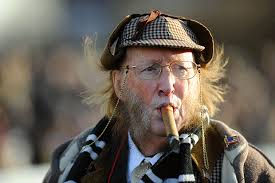
John McCririck
And there were office losers, too. The eccentric, deer-stalker and cape-wearing Old Harrovian, John McCririck, an award-winning racing writer for The Sporting Life, was twice bailed out by his overly-tolerant Mirror Newspapers group employers.
Once, it was said he owed racecourse bookmakers a five-figure sum and their intimidating enforcers had warned that if he didn't pay up, he would be soon appearing as a concrete tunnel support on the M25 motorway.
What united and drove both winners and losers is the thought that the market was not entirely straight; that with a bit of nous, homework or a tip from the horse's mouth - or at least a poorly-paid stablehand looking for a small windfall - they could beat the odds.
One racing journo on the Daily Mail famously got wind that the Miss World competition was rigged. When he failed to turn up for work, we learned he had had the first three in the correct order and won enough to buy an apartment in Regents Park.
Wherever there is money and gambling, there is at least a risk that the dice can be loaded.
The wisdom among racing writers was that if you wanted to make sure you were betting in an entirely fair field, you did so when the biggest prizes were on offer, such as in the Classics like the Derby, Guineas and star meetings' biggest races. Skulduggery was more likely in 'routine' meetings, away from the bigger crowds and the glamour and media attention.

Frankie Dettori wins The Derby
As for the betting industry itself, we see rampant profits, exploitative, pervasive advertising – and the most dangerous and distasteful tactic of all: using sports and sportspeople and teams as advertising hoardings.
Those at the top of the industry are the new moguls, the titans of 'industry'. I put the word industry in quotes as the only thing these people make are profits.
Denise Coates, head of Bet365, was paid £323 million last year – a record for a chief executive of a UK company.
Ms Coates founded the online betting group with her brother John in a Portakabin in Stoke-on-Trent almost 20 years ago, and last year received a salary of £277m – up 26 per cent in a year.
She was also awarded a 50 per cent share of a £92.5m dividend, cementing her position as one of the world’s highest-paid executives. According to the Forbes list of billionaires, Ms Coates has a net worth of US$12.2bn.
Stoke is a city of six towns that owes its existence to pottery and where decrepit 19th-century homes have been sold off for £1 (with £30k repayable loans for their renovation) to try to breathe life back into the place now much of the pottery industry has gone abroad.
In its glory days, huge fortunes were made by the likes of Josiah Wedgwood from mixing local clay with flint to make 'creamware' that sold worldwide.
It was hard, dirty work for many – but even Wedgwood would surely blanch at the success of Bet365 and the boundless wealth it has brought the Coates family. The difference is, Wedgwood has something quantifiable to show for his industry, the same can not be said of the betting firm.

Denise Coates, of Bet365
To be fair, Mrs Coates likely paid around £125m in tax but her earnings prompted criticism from gambling campaigners such as Brian Chappell, founder of the consumer rights group Justice For Punters. “Is it ethical for anyone to earn £1.3m a day?
"When you combine that with coming from an industry where if gamblers are any good
they will get shut down or if they are a heavy loser there is a good chance they will get made a VIP and showered with 'gifts' enticing them to bet even more in an effort to chase their losses.”
Adam Bradford, director of the Safer Online Gambling Group, called on Ms Coates to donate 10 per cent of her salary to help problem gamblers, though she says Bet365 had donated £85m to her charitable foundation.
In any other industry, Bet365 and the Coates family would be lauded as a success. But there is so much collateral damage from gambling and it largely goes unseen.
Drinkers are easier to spot, wobbling home after a heavy session. The real problem drinkers will have a secret home mini-bar, perhaps under the sink next to the bleach. And no, Domestos is not the Lidl own-branded vodka.
Excessive drugs users end up burdening the emergency services, the courts or the NHS. They are behind so much low-end crime and blight countless lives.
We seldom see the damage done by gambling away every penny – often before it is earned (although the laws on credit card use are being tightened this Spring).
The lure of a big win to at least temporary alleviate the dullness or poverty in people's lives is a magnetic draw for so many vulnerable people, and addiction is far too prevalent, again adding to the burden on the NHS.

Fred Done of Betfred
Recent news of one betting company making a fortune from gambling addiction services paid for by taxpayers truly sticks in the throat and underscores the fact that it is an industry being allowed to feast on the carcasses of the victims they themselves help create.
Billionaire brothers Fred and Peter Done run Betfred, plus a company that provides counselling to staff across the public sector affected by gambling problems. Their firm, Health Assured, has contracts worth at least £2.5million with dozens of NHS Trusts and councils.
They advertise help for problems including gambling and depression and the brothers have taken £5.2million in dividends from the business in the past three years.
This is akin to computer anti-virus software sellers writing the viruses that their software then removes from your laptop.
At the very least, the company should be allowed nowhere near our health services, and be compelled by law to contribute financially to NHS services.
Shadow health secretary, Jon Ashworth, said the fact the Dones were profiting from betting and from gambling addiction treatment showed an “unacceptable conflict of interest”.
Betting firms have been gaming the system for too long with the support, if not the connivance, of government.

Stuart Wheeler, of IG Index
In 2001, Stuart Wheeler, of IG Index, another big gambling firm, donated £5m (a record sum at the time) to the Conservatives' election pot.
Betfred have donated £375,000 to the Conservatives since 2016.
Bookmakers Ladbrokes appeared 15 times in a 2016 list of gifts given to MPs by private businesses and individuals – significantly more than any other company in a list dominated by sports and betting companies.
Of 187 donations from British sources since the start of that year, almost a third came from sports and betting businesses.
Half the current Premier League clubs are sponsored by betting firms. And Wayne Rooney's return to English football with Derby County has been financed by betting firm 32Red – the team have the company name on their shirts and the former England captain has 32 on his back. And young kids pester their parents for the replica shirt.

Wayne Rooney signing for Derby County
Golf, cricket and especially snooker are all happy to prostitute themselves for riches from the betting firms, which in my view makes them – even Rooney, who should be setting an example to youngsters – complicit in exploiting those with gambling problems.
Sport has been down this road with alcohol and tobacco sponsorship. That was stopped – and so must the betting firms.
Their grip is way too pernicious and lax legislation has allowed them to become ever more ruthless and exploitative, especially since the advent of smartphones and social media.
It was telling that the former Sports Minister Tracey Crouch had to resign in November 2018 to get Theresa May's government to finally crack down on those mesmeric fixed-odds gaming machines, getting stakes reduced from £100 to £2 in a given time frame.
She also chaired a parliamentary committee on alcohol misuse and the government eventually, if reluctantly, gave ground. How that must have annoyed many party donors.
Now we need someone to take Crouch's crusade to another level and ban betting advertising from sport and from sports TV programs, stadium and shirt advertising.
There will be the usual bleating from the sports industry that it will be a mortal body blow to clubs and sports themselves. It was said the loss of cash from tobacco and alcohol firms would be fatal. It wasn't.
It is time to be extra tough on the gambling industry. It has had its own way for too long and is making obscene profits from people's misery.
But I fear the industry has already bought all the influence it needs to save itself from such a fundamental reform.
All we will get is a little tinkering around the edges, some ineffective gesture policies. While lives continue to be blighted.


Comments